
Memory & Knowledge Layer
The Company Brain keeps memory in layers: raw source content, semantic memory events, and a self-learning loop that turns completed work into reusable experience.
The memory layer is where everything the brain knows lives. It is much more than storage. Raw retrieval is only the floor. On top of it, the brain distills your data into events, learns how those events relate, and continuously turns finished work into reusable experience. The result is a memory that understands, not just one that stores.
A layered memory#
The raw store#
At the bottom, the brain keeps the original content alongside vector embeddings and a keyword index, so anything can be found either by meaning or by exact term. This makes the source material fully retrievable, but on its own it is a flat pile of text. It is the foundation, not the substance.
The semantic layer: memory events#
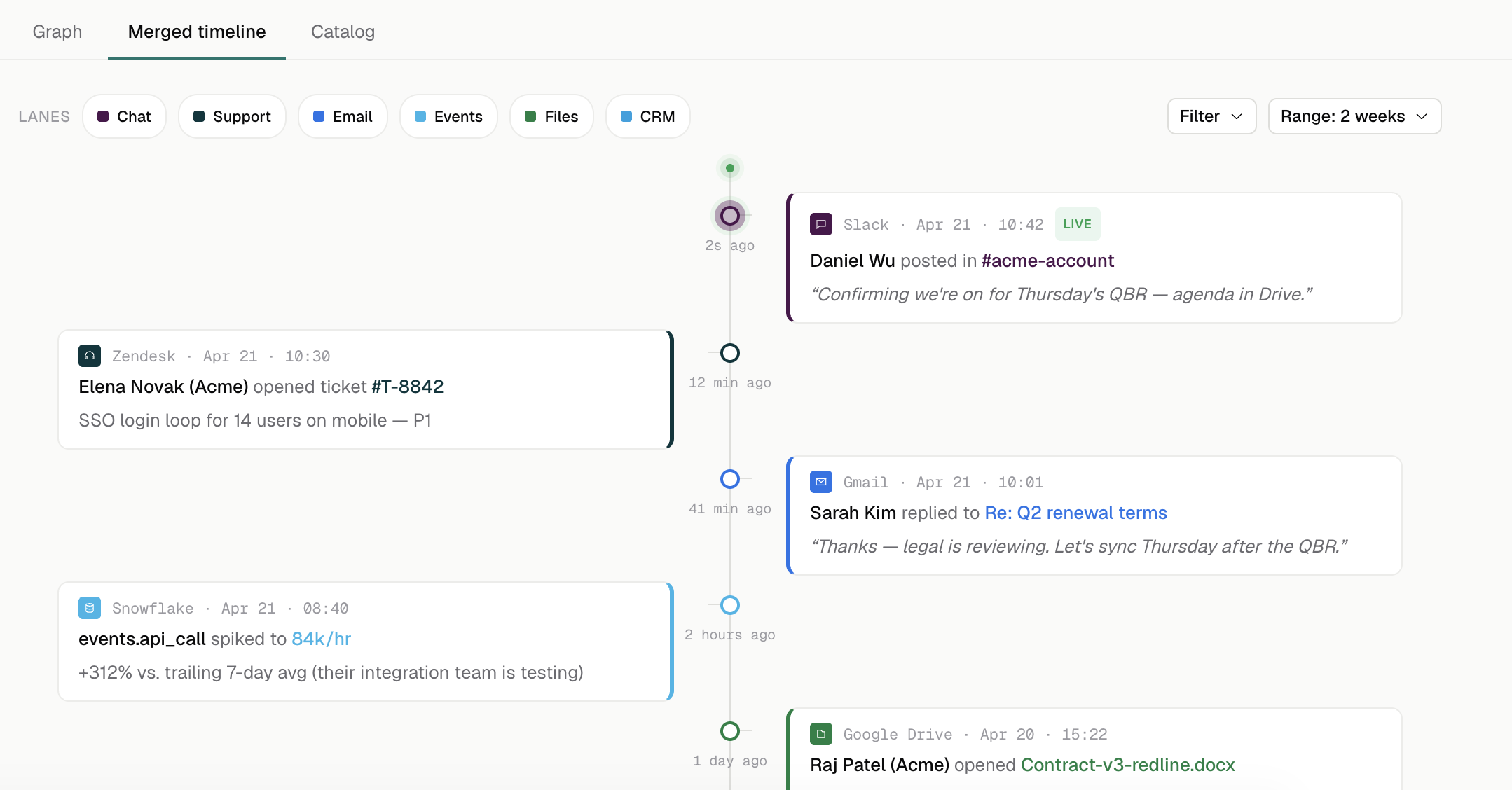
The substance of memory lives one layer up. The brain analyzes the raw material and distills it into events: meaningful happenings extracted from your data. Each event carries:
- A description: what happened, in concise, structured form.
- A timeline: when it happened and how it unfolded.
Events are the primary unit of memory. When an agent asks something, the brain reasons over events first and only opens the original source when an event needs more detail. Crucially, the brain then analyzes the relationships between events, building a connected, semantic memory rather than a disconnected archive. This is what lets the brain answer with context and continuity instead of isolated snippets.
Three kinds of memory#
The brain draws on three distinct kinds of memory, each with a different source, reliability, and lifecycle:
| Factual Memory | Experiential Memory | Working Memory | |
|---|---|---|---|
| Source | Read directly from your data sources | Inferred, and learned from agent interactions | The current chat, user instructions, agent outputs, and task context |
| Correctness | Always true; changes only when the source changes | Verified and refined over time. When unclear, will ask the user for clarifying questions. | Session-bound while active; useful records are saved back into persistent memory |
| Lifecycle | Persistent; periodically re-synced | Persistent; continuously evolving | Used during the task, then promoted into shared memory with relevant information. |
Continuous learning stream#
The continuous learning stream shows what the brain figured out from new evidence: entities discovered, relationships inferred, duplicates folded, and rankings updated.
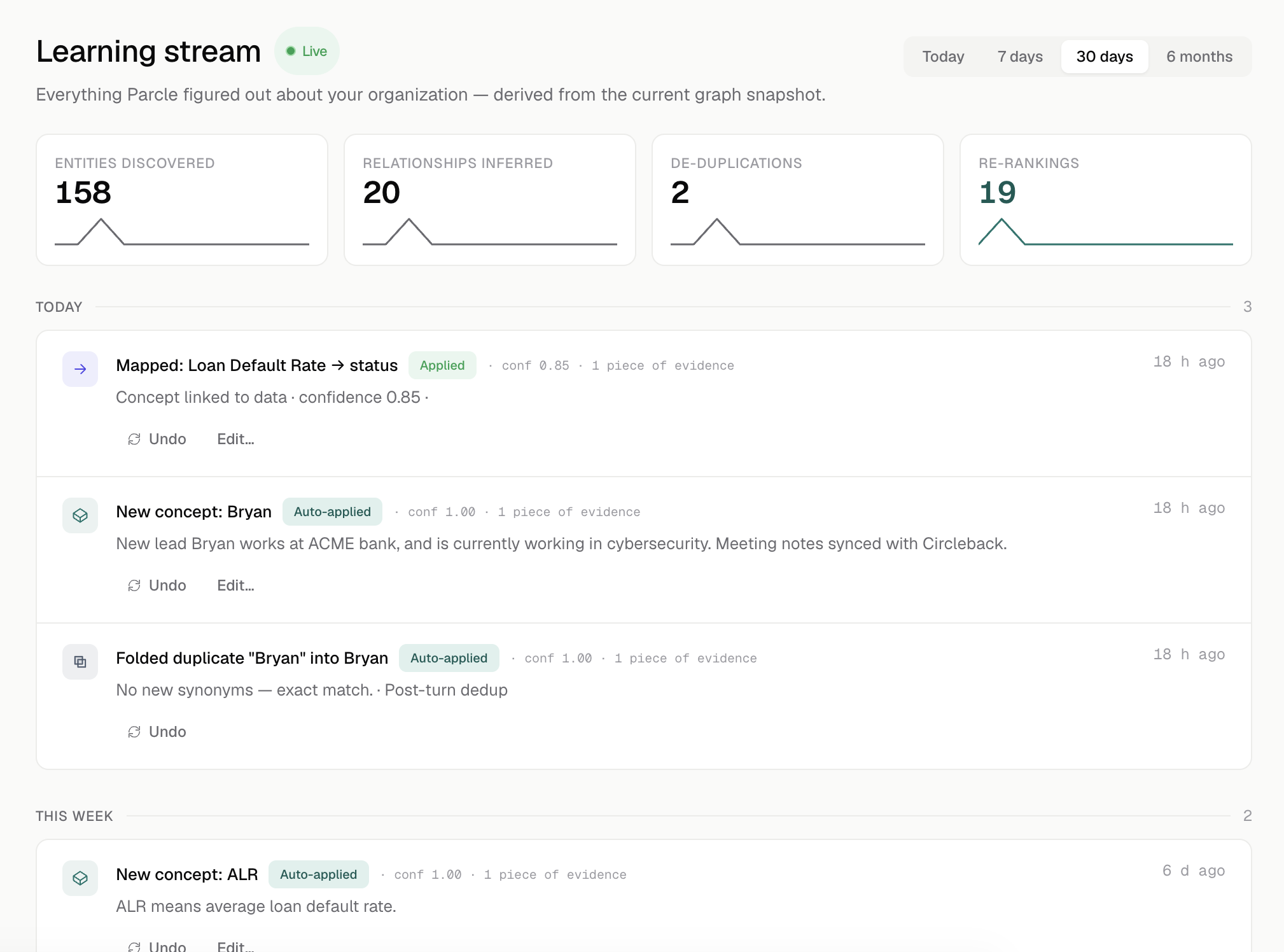
When an agent finishes a task or chat session, the brain summarizes what happened: the user conversation, the approach, the steps, the outputs, and the outcome.
That summary is archived as reusable experiential memory, related to the events around it, so future agents can remember past conversations and previous work.
Later, when any agent meets a similar task, the brain surfaces that experience so the agent can apply it instead of starting from scratch.
Because the brain is company-shared, a lesson learned by one agent becomes available to every agent. Your fleet does not just remember facts. It remembers interactions, user conversations, and agent outputs, giving every agent a persistent brain that gets better the more it works.
Shared and governed#
All of this is company-shared by design: one brain, reachable by every agent. But shared never means wide open. Access to memory is governed by company permissions, and every retrieval is recorded for audit. See Security and SSO & Audit.
How factual memory becomes a semantic map of your structured data.