
Connectors
Connectors ingest data into the Company Brain and retrieve source-backed information for agents. Connect warehouses, document stores, and SaaS tools once instead of wiring every agent to every source.
Connectors are the interface between source systems and the Company Brain. They ingest data into the brain, keep it current, and retrieve source-backed information when an agent needs context.
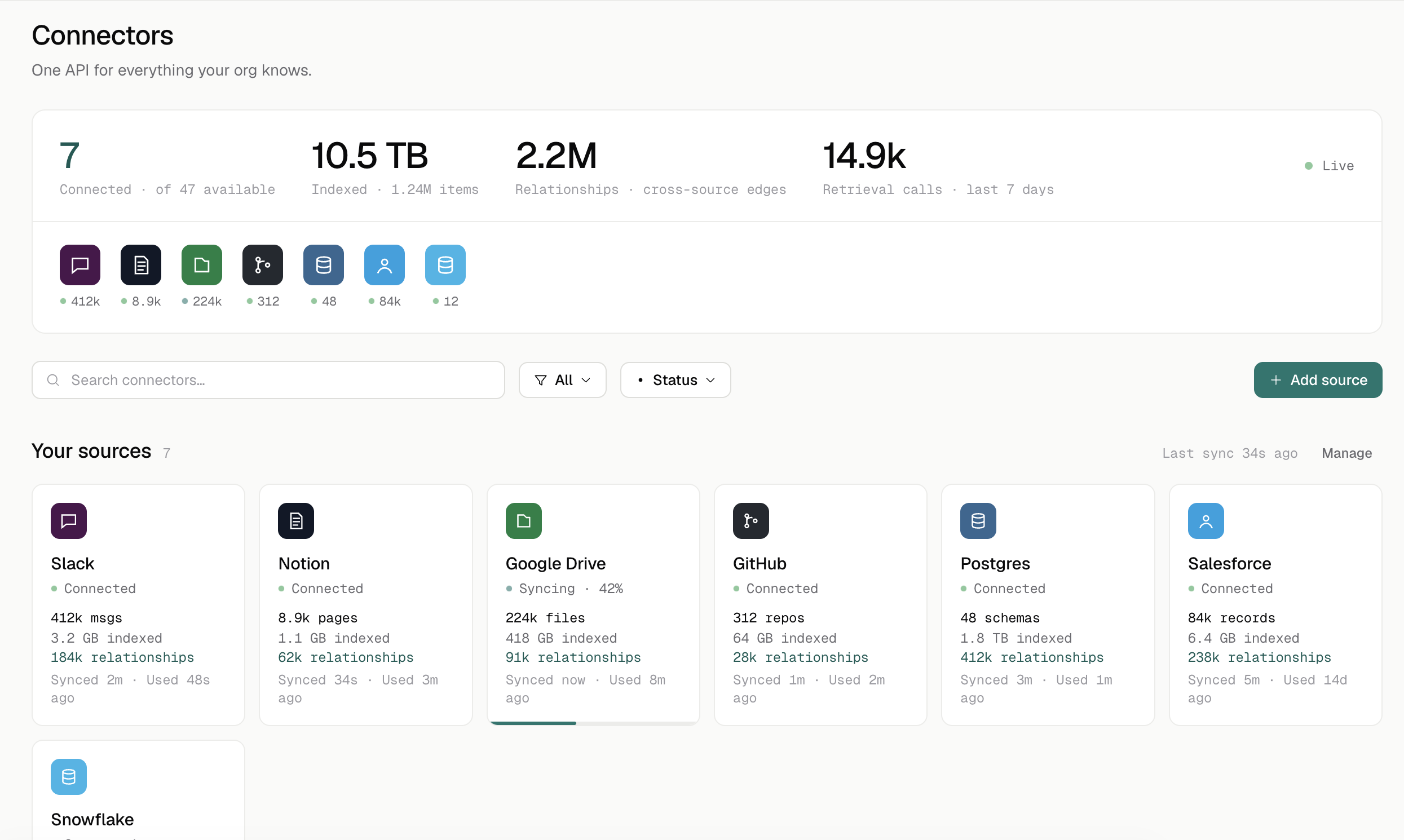
Connectors vs. Integrations. Connectors connect source systems to the brain for two jobs: ingesting data and retrieving relevant information when agents need it. Integrations are how agents consume the brain inside their workflows. Both share the same control plane, so a source you connect once is available to every permitted agent.
How connectors work#
The pattern is always the same: connect the source, let Parcle ingest and index it, then retrieve the right information through the brain. Each connector understands the native shape of its source, so you do not transform or reformat anything before importing.
Source system -> Connector (ingests + retrieves) -> Company Brain (memory + Ontology Graph) -> Permitted agentsOnce a source is connected, the connector keeps its content flowing into the brain, keeps the Ontology Graph current without manual uploads, and retrieves the relevant pieces for any agent permitted to use them.
Source families#
Structured sources such as Snowflake and Databricks are connected as live data sources. Parcle reads them in place to build factual knowledge and infer business concepts, which powers natural-language analytics over your structured data without copying it.
Document and record sources such as Google Drive, Notion, GitHub, HubSpot, and Linear, plus 30+ more. Parcle ingests each source's content and makes it searchable and retrievable as part of the brain.
Supported connectors#
For enterprise deployments, the supported named connectors cover the systems where company context usually lives:





Generic interfaces#
For sources that do not need a named connector, Parcle also supports generic connector paths:
What connecting a source does#
Connecting a source is a single, low-effort action. From that point on, Parcle does the rest:
Each connector understands its source natively, so there's nothing to export, reformat, or map by hand. You connect; Parcle adapts.
Whatever its shape, the source becomes part of the company's shared brain, so disconnected systems stop being silos and become one body of knowledge any agent can reason over.
The brain evolves with the source, staying live as it changes without duplication or manual upkeep.
One source, every agent#
The practical benefit of connecting centrally is simple: a source you connect once becomes available for every permitted agent to retrieve and reason over, governed by the same access policies. There is no per-agent connection to build, maintain, or secure separately.
Where connected content lives, and how it's shared and governed.