
Memory Events
Your Personal Brain keeps memory in layers: the raw chats and files you bring in, semantic memory events on a timeline, and the relationships between them.
Memory is where everything you bring in lives. It is much more than storage. Raw retrieval is only the floor. On top of it, the brain distills your chats and files into events, learns how they relate, and keeps them on a timeline. The result is a memory that understands your history, not just one that stores it.
A layered memory#
The raw store#
At the bottom, the brain keeps your original chats and files alongside vector embeddings and a keyword index, so anything can be found either by meaning or by exact term. This makes your source material fully retrievable, but on its own it is a flat pile of text. It is the foundation, not the substance.
The semantic layer: memory events#
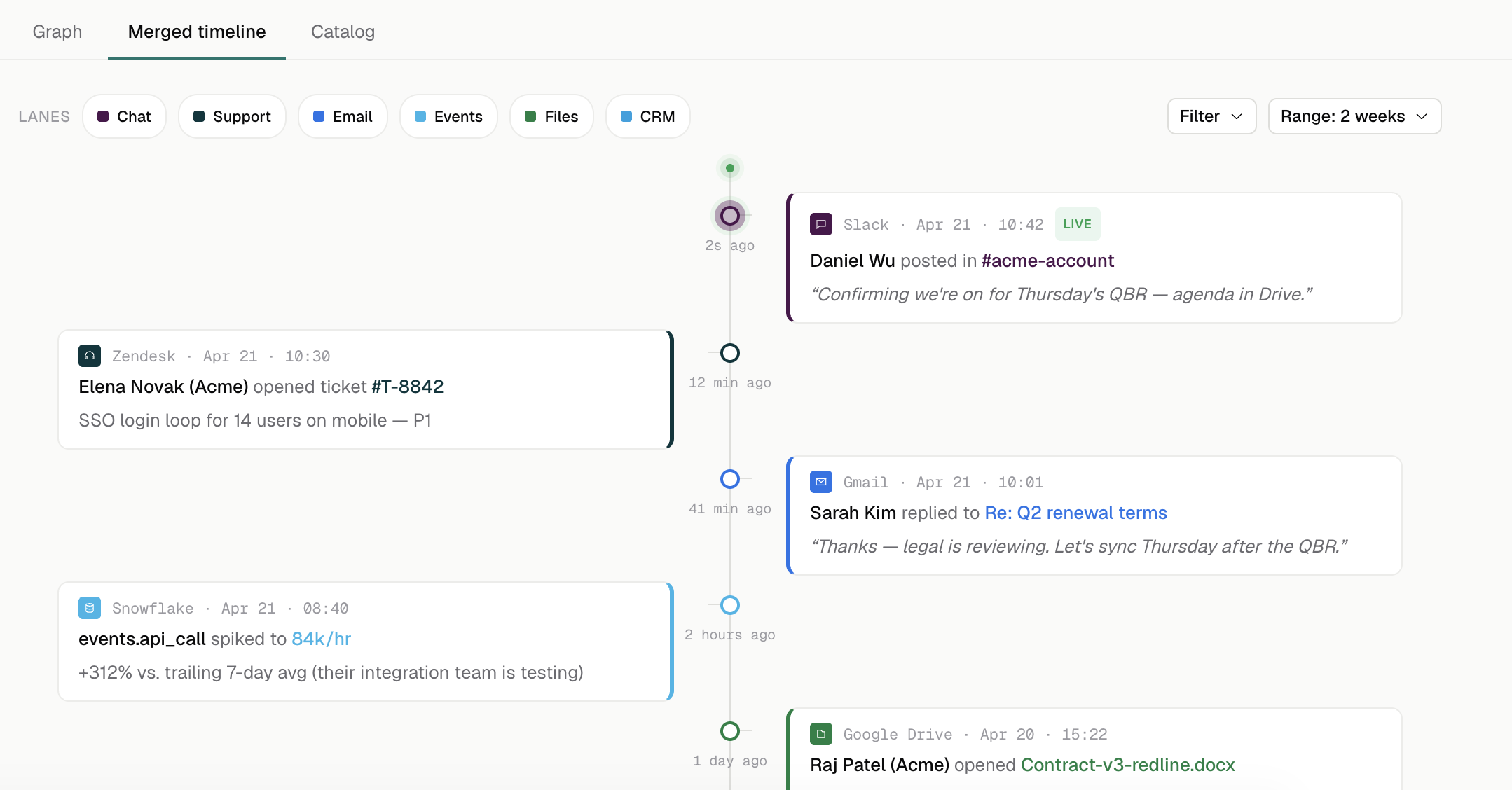
The substance of memory lives one layer up. The brain analyzes the raw material and distills it into events: meaningful things that happened, extracted from your data. Each event carries:
- A description: what happened, in concise, structured form.
- A timeline: when it happened and how it unfolded.
Events are the primary unit of memory. When an agent asks something, the brain reasons over events first and only opens the original chat or file when an event needs more detail. It then maps the relationships between events, building a connected memory rather than a disconnected archive. This is what lets your brain answer with context and continuity instead of isolated snippets.
Three kinds of memory#
The brain draws on three distinct kinds of memory, each with a different source, reliability, and lifecycle:
| Factual Memory | Experiential Memory | Working Memory | |
|---|---|---|---|
| Source | Read directly from your chats and files | Inferred and learned from how you work | The current chat, your instructions, and task context |
| Correctness | Plainly true; changes only when your data changes | Verified and refined over time; when unclear, the agent can ask you | Session-bound while active; useful records are saved back into persistent memory |
| Lifecycle | Persistent; re-synced when you add or change data | Persistent; continuously evolving | Used during the task, then promoted into memory with what's worth keeping |
Private by default#
All of this is yours alone. Your memory is scoped to your user id and never shared with another user's brain. Ingestion, search, and deletion all operate inside that boundary. Delete a chat, a file, or anything under a tag, and it is gone from your memory. See the Memory API for how ingestion, search, and deletion work.
How your memory becomes a semantic map of the concepts you use.